

Sixth Form Prospectus
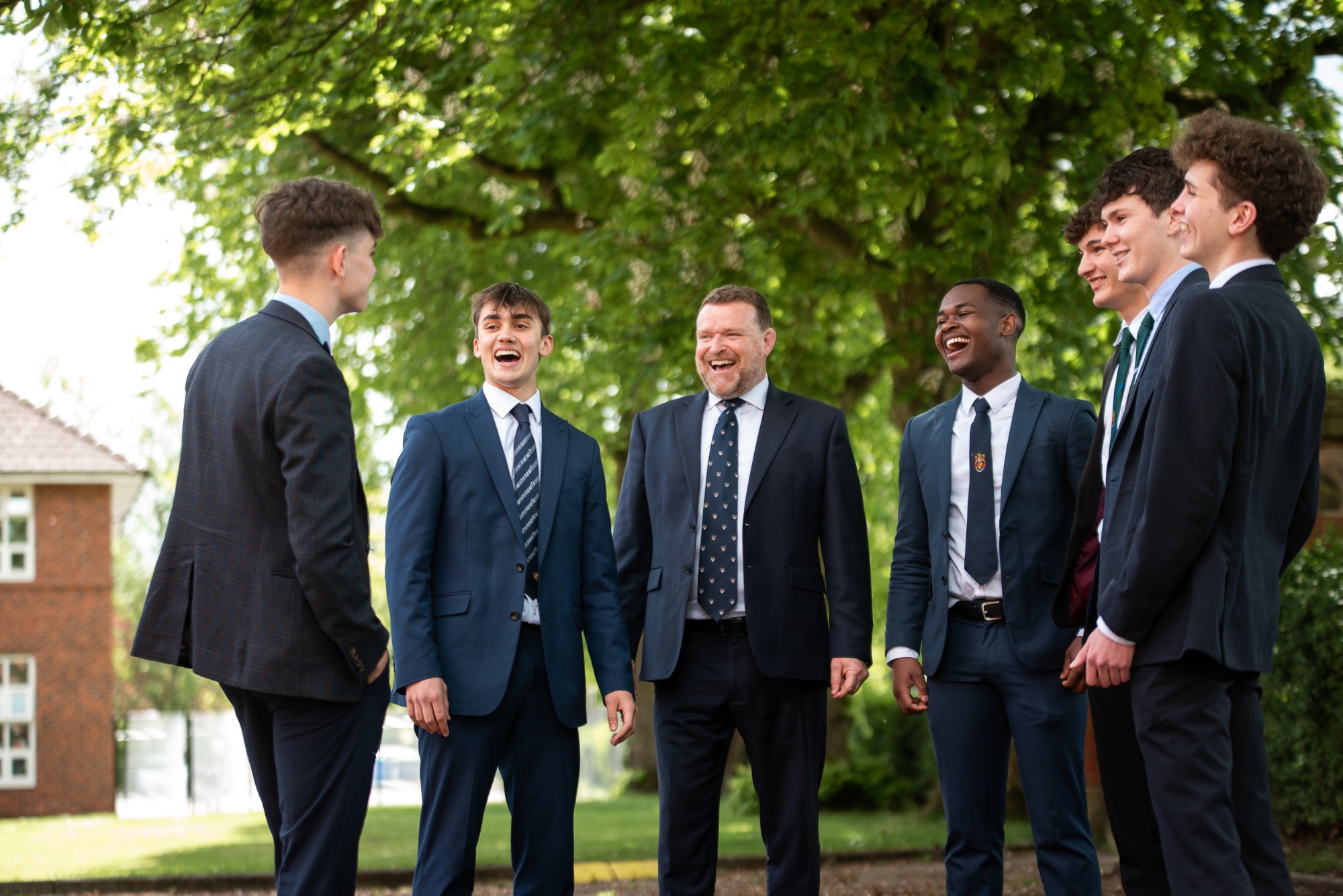


Altrincham Grammar School for Boys is established as one of the country’s leading state selective schools for boys ages 11 to 18. Since the 1990’s, the Sixth Form has seen considerable development, both in size and facilities, to the extent that Sixth Form students now constitute a quarter of the total School roll. AGSB offers a broad and balanced curriculum that will assist in equipping Sixth Form students with the skills required for employment or Higher Education.
We welcome students who are willing to work hard and contribute to the life of the school. Altrincham Grammar School for Boys offers:
- A wide range of A Level courses which will provide a suitable foundation for degree level study
- A range of curricular options to support their acquisition of the wider skills that will be essential for success in their lives and future careers
- A strong record of A Level success, both in terms of pass rate and the percentage of entries achieving A*, A or B grades
- High numbers of students going on to leading universities, including Oxbridge and other Russell Group Universities
- A structured and supportive learning environment with appropriate guidance and pastoral support
- A wide range of extra-curricular activities which will provide opportunities for leadership and responsibility
Sixth Form students will find their lessons, whether they are in laboratories, workshops or classrooms, timetabled in the main body of the school. However, the Sixth Form Centre provides the nexus of their time here. There is a large social area, a dedicated catering area and café, as well as three private study areas. The Sixth Form Leadership team is also based here and provides a readily accessible source of guidance and support.
Sixth Formers at AGSB have a distinctive position in relation to the rest of the school. Whilst they have their own designated social and study facilities, there are separate arrangements for uniform and for going off site. However, students also have to recognise that they are part of an 11 – 18 school and, that as the most senior students, they are required to set an example to the junior pupils. We have a small number of rules and regulations which we require Sixth Form students to adhere to so that the school runs as efficiently as possible. In the Sixth Form, students are also expected to take more control of their own learning.
Pastorally, our Sixth Form team has a wealth of experience in supporting students as they mature both personally and academically, and we are proud of the level of support that each student can expect.
If you need a second opinion, ask our Sixth Form students. The overwhelming majority have enjoyed their Sixth Form course and the quality of teaching and pastoral support they have been given. Every year we ask our departing Year 13 students their views on their Sixth Form experience. The in-depth comments we receive result in real change to the benefit of future students.

“Having joined from Year 12, I would recommend the school. It was very welcoming with friendly staff and students who actively helped me settle in”
“The competition is tangible and a huge incentive to work”
“Staff have been especially helpful in organising work shadowing and preparing me for applications and interviews”
Welcome from the Sixth Form Head
I am delighted that you would like to secure a place in our Sixth Form. Altrincham Grammar School for Boys is one of the country’s leading state selective schools and our Sixth Form is the pinnacle of a student’s school career.
“Students in the sixth form are an example and inspiration to younger pupils. They display high aspirations, strength of character and a can-do attitude to learning. They do so with humility.” Ofsted 2022
We offer a broad and balanced curriculum that will equip students with the skills for success in employment and Higher Education. We welcome students who are willing to work hard and contribute to the life of the school.
There are a number of places available for external applicants and I anticipate making around 20 offers to external students to study in September 2026. Whilst places do exist for studying the full range of STEM subjects, we do have a number of places available to study Humanities, Arts and Languages. You will find a high quality of Teaching and Learning, alongside similarly able students, in whatever subject or combination of subjects you choose.
Our Sixth Form is not just about the pursuit of academic excellence. We also want our students to get involved and a variety of opportunities exist for them to contribute to the general life of the school and the wider community. Our Sixth Form students “are positive role models and a shining example to their peers.” Ofsted 2022
If you need a second opinion about any of our subjects or the Sixth Form experience, please talk to any of our students during our Open Evening event. Should you have any questions about our Sixth Form, please do not hesitate to get in touch.
Tom Murray
Head of Sixth Form
2026 Admissions Criteria
Entry into Year 12
Experience shows that those who have not reached a high level at GCSE are rarely successful in an academic sixth form offering only ‘A’ levels. That is not to say they may not be capable of passing ‘A’ levels on a mixed course such as those offered by some other institutions, but simply that the traditional sixth form, offering a package of 3 or 4 ‘A’ Levels, is not the best place for them. We therefore make the following stipulation:
For those offered a place in the Sixth Form, the requirement for entry is that students must have achieved a minimum Attainment 8 score of 62 and at least a grade 5 in GCSE English Language and Mathematics. Applicants must also achieve the minimum grade in the related GCSE subjects in order to study at A level.
Please note that, for the purposes of our entry criteria, the Attainment 8 score is defined as a summation of the grades students achieve in their best 8 GCSEs, including Mathematics and English Language. A student's Mathematics GCSE and English Language GCSE grades will be included in this measure and both the Mathematics and English Language grades will be double weighted. For example, a score of 8 in English Language will be awarded 16 points towards the minimum target of 62. The remaining 6 GCSEs are not double weighted and can come from any other GCSE subject studied by the students as part of the AGSB curriculum, or equivalent subjects at a different school.
Each year we are delighted to welcome a number of students from other schools who choose to join our Sixth Form. The criteria applied to their admission are the same as those for internal candidates set out above, although, of course this will depend on places being available. Where places for external candidates are likely to be available, these will initially be allocated in accordance with our admission criteria.
- External candidates are encouraged to apply between mid-October and early February during Year 11. Deadlines and details can be found on our online application page Sixth Form External Applications
- All internal Year 11 students will be issued with application forms in January and these should be returned in February.
- A copy of our Admissions Policy is available on the school's website at Admission Policies
subjects available
The number of combinations theoretically possible is far in excess of what is, in practice, possible to timetable. Therefore, it must be understood that while we will do our best to accommodate all first choices, it may not be possible, or indeed desirable, to provide all combinations.
art
WHY STUDY Art at A-Level?
Studying AQA, Art A Level is important because it develops both creative and critical thinking skills that are valuable far beyond the subject itself. It encourages students to explore their own ideas, experiment with different materials and techniques, and build a personal artistic style while learning to analyse and interpret the work of other artists.
This course also helps improve time management, independence, and problem-solving, as students must plan, develop, and refine their projects over an extended period. Additionally, it provides a strong foundation for careers in creative industries such as design, architecture, media, and fine art, while also supporting university applications by demonstrating originality, dedication, and the ability to think in innovative ways
What you will study?
Component 1: Personal Investigation 60% of total A Level marks. A personal project of practical work, set through discussion with the
Teachers, and supported by 1000 – 3000 words. Marked by the Centre, moderated by AQA.
Component 2: Externally Set Assignment 40% of total A Level mark
An exam paper containing several starting points will be provided by AQA, with a fixed period of preparatory time and a supervised time of fifteen hours for the final piece of work. Marked by the Centre, moderated by AQA.
Exam Board and how the subject is assessed
AQA
Component 1: Personal Investigation 60% of total A Level marks.
Component 2: Externally Set Assignment 40% of total A Level marks.
Marked by the Centre, moderated by AQA.
opportunities on the course
Year 12 students take part in ARTiculation - This develops their confidence and ability to express their opinions, thoughts and conclusions through discussion work of art, architecture or an artefact of their choice.
This is an opportunity to represent their school /college at regional heats or regional finals which take place at museums and galleries across the country.
Please view our KS5 curriculum page for further details:
biology
WHY STUDY biology at a-level?
Choosing A‑level Biology opens doors. It builds a strong understanding of how living systems work and develops analytical, practical and problem‑solving skills that are valuable in almost any future path. Biology links naturally to careers in medicine, healthcare, psychology and the social sciences, but it also connects with geography through conservation and climate science, and with engineering through biomedical and medical‑physics fields.
It’s equally useful in less obvious areas such as business, law and communication, where biological knowledge supports work in health economics, science policy and science journalism. Whatever direction you take, Biology stays relevant and keeps your options wide.
What you will study?
The course is divided into eight core units:
- Biological Molecules
- Cells
- Organisms Exchange Substances with Their Environment
- Genetic Information, Variation and Relationships Between Organisms
- Energy Transfers in and Between Organisms
- Organisms Respond to Changes in Their Internal and External Environments
- Genetics, Populations, Evolution and Ecosystems
- The Control of Gene Expression
In addition, students must achieve the Practical Endorsement by the end of the two-year course. This involves completing 12 required practical investigations and documenting them to meet the Common Practical Assessment Criteria (CPAC).
Exam Board and how the subject is assessed
AQA - This is a linear AQA A level qualification. Students sit three examination papers at the end of two years of study.
Paper 1
What's assessed: Any content from topics 1– 4, including relevant practical skills
Assessed by: written exam: 2 hours 91 marks - 35% of A-level
Question type: 76 marks: a mixture of short and long answer questions
15 marks: extended response - questions
Paper 2
What's assessed - Any content from topics 5 – 8, including relevant practical skills
Assessed by - Written exam: 2 hours 91 marks - 35% of A-level
Question type - 76 marks: a mixture of short and long answer questions
15 marks: comprehension - question
Paper 3
What's assessed: Any content from topics 1– 8, including relevant practical skills
Assessed by: written exam: 2 hours 78 marks - 30% of A-level
Question type: 38 marks: structured questions, including practical techniques
15 marks: critical analysis of given experimental data
25 marks: one essay from a choice of two titles
opportunities on the course
Our Biology department encourages students to get involved in extracurricular activities that strengthen subject knowledge, build confidence and develop independence beyond the classroom. These opportunities help pupils grow into self‑motivated learners ready for further study.
Students can take part in the Biology Olympiad, explore academic writing through Cambridge essay competitions, or join the Institute for Research in Schools, where they carry out real scientific research and present their findings at the IRIS Manchester Conference. These conferences allow pupils to share their work with peers, scientists and industry researchers, offering valuable networking experiences and a genuine insight into how scientific research happens in the real world. Added to this, our Head of Careers work with AGSB alumni to give inspirational talks throughout the year on many careers that are linked to A level Biology.
Please view our KS5 curriculum page for further details:
business studies
WHY STUDY business studies at a-level?
A-level Business offers students an engaging and contemporary insight into how businesses operate in an increasingly dynamic and global environment. The newly updated AQA specification has been redesigned to reflect the realities of modern business, with a stronger focus on digital transformation, sustainability, ethics and the evolving workplace.
Students will develop a deep understanding of how businesses make decisions, compete in markets and respond to change, while building valuable analytical and evaluation skills that are highly regarded by universities and employers.
Students will gain a wide range of transferable skills, including:
- Critical thinking and problem-solving
- Data interpretation and quantitative skills
- Decision-making under uncertainty
- Written communication and argument development
Progression
A-level Business provides an excellent foundation for degrees in Business Management, Economics, Marketing, Finance and related fields. It also supports progression into apprenticeships and careers in areas such as management, entrepreneurship, accounting and consultancy
What you will study?
The course is structured around key functional areas of business and strategic decision-making. Students will study three key units:
Unit 1: What is business? Managing marketing and finance
1.1 Business and objectives
1.2 Forms of business and stakeholders
1.3 Marketing management
1.4 Financial management
Unit 2: Managing people and operations
2.1 People management
2.2 Operations management
2.3 Managing business culture
Unit 3: Business and society, business and the external environment, and business strategy
3.1 Business and society
3.2 Business and the external environment
3.3 Strategy
3.4 Change
Throughout the course, students will explore real-world case studies and develop the ability to apply theory to current business issues.
Exam Board and how the subject is assessed
AQA
A-level Business is assessed through three written examinations at the end of Year 13.
- All papers assess the full range of content
- A mixture of multiple-choice, short-answer, data response and extended essay questions
- Strong emphasis on defining, explaining, analysing, assessing and evaluating content studied and scenarios given.
There is no coursework, and all assessment is exam-based.
opportunities on the course
Students studying A-level Business will have the opportunity to attend and take a leading role in the department’s three societies: Business, Finance and Economics. They will be encouraged to participate in debates, carry out research, and present on current business and economic issues, while also developing their financial literacy and accounting skills.
To enhance their understanding of the complexities of modern business, students will also have the opportunity to take part in planned educational visits to organisations such as Amazon and Jaguar Land Rover.
Please view our KS5 curriculum page for further details:
chemistry
WHY STUDY CHEMISTRY at a-level?
Many university degree courses such as Medicine and Veterinary Science place an enormous value on an A-level qualification in Chemistry and demand the highest grades. However, our students have used their qualifications in a wide variety of jobs in research and industry such as pharmaceuticals, mining, forensic science, textiles, foodstuffs, oil industry and many others.
Others have opted for Chemistry degrees and then gone on to additional study to become lawyers.
One of the most important aspects of Chemistry is in the development of transferable skills. You will need to demonstrate critical thinking, data analysis and complex multi-step problem solving abilities. The course involves hands-on experiments, developing technical skills, precision, and safety awareness.
What you will study?
We build upon your GCSE knowledge, refining and extending ideas and concepts, as well as introducing new ones.
A Level Chemistry allows time for in-depth study in the three chemical strands (Physical,
Organic and Inorganic).
You can find the details in the specification at AQA.org.uk.
Exam Board and how the subject is assessed
AQA Chemistry Syllabus (7405)
Assessed over three papers at the end of Y13. In addition, you will complete a series of required practicals to get a Practical Skills Qualification.
opportunities on the course
Students will receive a top-class education in A level Chemistry based upon decades of experience within the department delivering the AQA syllabus.
In addition, students will also have the opportunity to enter the Chemistry challenge for Y12 run by Cambridge University.
We don’t have trips and residentials, but what we do have is an enthusiastic staff who want to make the study of Chemistry as engaging and relevant as possible.
We are developing the use of A level students to act as mentors for GCSE students to help and support the next generation of Chemists.
Please view our KS5 curriculum page for further details:
computer science
WHY STUDY computer science at a-level?
Computer Science A level gives you skills that are relevant, valued, practical, creative, and in high demand in industry and the modern world.
Computer Science lies at the very heart of everything we now do. There are very few industries or careers that are not touched in some way or another by its frontiers.
Our social lives are also increasingly interwoven with new and existing technologies. And in this continuously developing, computer‐dependent world, there is an increasing need for technological skills, such as the ability to understand problems suitable for solution by computer, and the capability to construct and implement such a solution.
After all, someone needs to maintain our computer-based society and to push it forward to its next technological leaps.
Industry has highlighted the demand for people with Computer Science knowledge and skills, as well as the shortage of young people that have them. In today’s workplace, those with knowledge and skills in Computer Science will have the opportunity to pursue many new, exciting and well‐paid careers and to be instrumental in the conception of computer systems that increasingly shape work and leisure activities.
Computer Science also sits at the basis of many other academic fields; disciplines as varied as engineering, aerospace, surgery, computational biology, space industries, genetics, neuroscience, sociology and anthropology all depend heavily on computers and the science behind them.
To meet these varied career challenges and opportunities, students must be self‐reliant as well as good communicators and problem solvers. They need interpersonal, academic, and possess technical skills.
They must demonstrate an ability to work independently and as part of a team. They also need to develop an ethical approach to the use of computers. The Computer Science A level aims to provide and enhance these must have skills.
What you will Study?
Component 1
Students are introduced to the internal workings of the (CPU), data exchange, software development, data types and legal and ethical issues. The resulting knowledge and understanding will underpin their work in component 03.
It covers:
- The characteristics of contemporary processors, input, output and storage devices
- Types of software and the different methodologies used to develop software
- Data exchange between different systems
- Data types, data structures and algorithms
- Legal, moral, cultural and ethical issues.
Component 2
This builds on component 01 to include computational thinking and problem-solving.
It covers:
- What is meant by computational thinking (thinking abstractly, thinking ahead, thinking procedurally etc.)
- Problem solving and programming – how computers and programs can be used to solve problems
- Algorithms and how they can be used to describe and solve problems.
Component 3
Students are expected to apply the principles of computational thinking to a practical coding programming project. They will analyse, design, develop, test, evaluate and document a program written in a suitable programming language. The project is designed to be independently chosen by the student and provides them with the flexibility to investigate projects within the diverse field of computer science. We support a wide and diverse range of languages.
- analyse a problem (10 marks)
- design (15 marks)
- develop and test (25 marks)
- evaluate and document (20 marks)
The program must be to solve it written in a suitable programming language.
exam Board and how the subject is assessed.
OCR (H466)
There are two exam papers at the end of the course:
Component 1
Computer Systems (40%)
Component 2
Algorithms and Programming (40%)
And a coursework-based project:
Component 3
Programming Project (20%)
opportunities on the course
There is a trip to the Bury arcade club, getting an idea for a coursework project by retro playing games experiencing gameplay, interactions and simplicity of the games from the era.
Sites and online courses which are useful for studying Computer Science at A level:
- CS50: Harvard’s computer science courses and certificates | edX
- W3Schools Online Web Tutorials
- Web Dev for Beginners - microsoft.github.io
Sites and Online courses which are useful for specific Computer Science based courses at university:
- MITx: Introduction to Computer Science and Programming Using Python. | edX
- MITx: Computational Thinking for Modelling and Simulation
- MITx: Understanding the World Through Data | edX
- MITx: Machine Learning with Python: from Linear Models to Deep Learning. | edX
Please view our KS5 curriculum page for further details:
design & technology
WHY STUDY design & technology at a-level?
Studying A-Level Design and Technology is an excellent choice for anyone looking to bridge the gap between creative innovation and practical application. This subject enables you to turn abstract ideas into tangible, working prototypes, giving you the skills to solve real-world problems.
Unlike strictly theoretical subjects, D&T builds technical knowledge in materials, manufacturing techniques, and modern digital design (CAD/CAM), while simultaneously strengthening critical thinking and analytical skills. This combination is highly regarded by both universities and employers, particularly within the competitive STEM and creative industries.
A-Level D&T fosters independence, resilience, and user-cantered design, preparing you for future careers in architecture, engineering, industrial design, or manufacturing. By engaging in iterative design projects, you will develop the ability to research, analyse, and refine your concepts, gaining high-quality, practical skills that are invaluable in any career path.
What you will study?
Technical Principles: Material science, Mechanical Engineering, Electronics, Structures, and Finishing.
Designing & Making: CAD/CAM, Prototyping, and Design Ergonomics.
Industrial Practice: Commercial Manufacture, Sustainability, Quality Control and Project Management
Exam Board and how the subject is assessed
EDEXCEL Design and Technology
Component 1 Principles of Design and Technology – 2.5 hour written examination that is worth 50% of the A Level.
Component 2 Coursework - 50% of A Level. A Product Design Task based on a theme of your choice lasting approximately 50 hours of contact time.
opportunities on the course
A wide variety of activities are available to support D+T students as shown in the links below:
- Young Engineers
- The Big Bang Engineering Contest
- Arkwright Engineering Scholarships
- Smallpiece Trust Courses
- Greenpower F24
Please view our KS5 curriculum page for further details:
economics
WHY STUDY economics at a-level?
Economics is widely regarded as a vitally important subject for any young person considering a future career in industry, commerce, or politics. At its heart, Economics is the study of how the world works. It helps students understand how scarce resources are allocated, the impact of government policies, and the far‑reaching effects of globalisation on individuals, businesses and economies.
Economics also explores the big questions that shape our everyday lives. Why is a luxury item such as a diamond more expensive than an essential like water? Why should the government subsidise public transport? Should footballers be allowed to earn £250,000 per week? What are the economic implications of Brexit and the Coronavirus pandemic? Why is China one of the fastest‑growing economies in the world, and how might that affect me?
Economics graduates enjoy some of the highest average earning potentials among university leavers. Many go on to careers in banking, insurance and law, or work as professional economists advising governments and multinational companies.
Studying A‑level Economics does not require prior knowledge of the subject at GCSE. The course is taught from first principles, and no previous study of Economics is assumed. The department follows the AQA A‑level specification.
What you will study?
The A-level qualification is split over two key topic areas: Microeconomics and Macroeconomics:
Microeconomics: Individuals, firms, markets and market failure
- The economic problem and economic methodology
- Individual economic decision making
- Price determination in a competitive market
- Production, costs and revenue
- Perfect competition, imperfectly competitive markets and monopoly
- The labour market
- The distribution of income and wealth: poverty and inequality
- The market mechanism, market failure and government intervention in markets
Macroeconomics: The national and international economy:
- The measurement of macroeconomic performance
- How the macroeconomy works: the circular flow of income, AD/AS analysis, and related concepts
- Economic performance
- Financial markets and monetary policy
- Fiscal policy and supply-side policies
- The international economy
Exam Board and how the subject is assessed
AQA
Students sit three two-hour exams at the end of year 13.
Paper 1 is on Microeconomics,
Paper 2 is on Macroeconomics
Paper 3 is combined.
Students are assessed on four key assessment objectives throughout the course:
AO1: Demonstrating knowledge of terms/concepts and theories/models to show an understanding of the behaviour of economic agents and how they are affected by and respond to economic issues
AO2: Applying knowledge and understanding to various economic contexts to show how economic agents are affected by and respond to economic issues
AO3: Analysing issues within economics, showing an understanding of their impact on economic agents
AO4: Evaluating economic arguments and use qualitative and quantitative evidence to support informed judgements relating to economic issues
opportunities on the course
EconplusDal talk, Bank of England talk, Student Investor competition, and the IEA budget challenge.
Students also have the opportunities to enter a number of Economic essay writing competitions such as Young Economist of the year and the IEA essay competition.
Students also have the chance to attend and run sessions at the departments Economic, Business and Finance societies.
Please view our KS5 curriculum page for further details:
english language
WHY STUDY English LANGUAGE at a-level?
“The limits of my language are the limits of my world.” (Wittgenstein)
English Language will appeal to students who love English but are mainly interested in language use in contemporary contexts such as journalism, social media, creative writing, business, TV, politics, advertising, and sport. Unlike English Literature which involves reading fiction texts, English Language is largely focussed on non-fiction and spoken texts such as articles, speeches, screenplays, and conversations.
If you’ve ever wondered how certain brands create such powerful identities, or why most of the world speaks English, or whether men and women use language differently, or how language manages to offend or entertain in equal measure…you will love English Language. For those who like their English studies modern and relevant, and who seek to master the technical aspects of language and become powerful communicators, English Language will be just the ticket.
What you will study?
The course begins with mastering linguistic terms and concepts – the building blocks of language study. Then we dive into the kaleidoscopic world of spoken language and all its humour, quirks and imperfections. Issues of power and identity are debated, including class, wealth, race, and gender. Next, we trace our language back to its origins by exploring the fascinating way babies and children acquire language, and the dramatic history of the English language itself from Shakespeare to the present day. Throughout the course we pause for spells of creative writing across many genres and forms. The NEA element offers students a chance to investigate a language topic of their own choice.
Exam Board and how the subject is assessed
WJEC-Eduqas A700QS
Paper 1 | Language Concepts and Issues - 2 hours | 30%
Paper 2 | Language Change Over Time - 2 hours 15 minutes | 30%
Paper 3 | Creative and Critical Uses of Language - 1 hour 45 minutes | 20%
NEA | Language and Identity, 2500-3500 words | 20%
opportunities on the course
A range of writers, journalists, broadcasters – many former students – visit to share their experiences of careers in media, marketing, creative industries and the arts. Students are encouraged to join the 6th Form Book Club, to discuss texts with students at AGGS and Sale Grammar. Trips take place to venues such as Manchester University, to explore Higher Education options, and John Rylands Library to explore their collection of historic texts.
Please view our KS5 curriculum page for further details:
english literature
WHY STUDY English literature at a-level?
English Literature appeals to students who love reading novels, poetry and plays. The subject introduces students to a wide array of writers and texts from a range of genres, cultures and eras. For those who love the adventure of reading, the cut and thrust of classroom debate, and the challenge of writing bold, critical essays, A‐level English Literature will be a joy.
You will study texts which explore different aspects of tragedy, including Shakespeare’s King Lear, Miller’s Death of a Salesman and Hardy’s Tess of the D’Urbervilles.
You will also study protest writing such as Blake’s Songs of Innocence and Experience, Jim Crace’s novel Harvest, and Atwood’s dystopian classic, The Handmaid’s Tale. You will also produce two pieces of coursework informed by study of a Critical Anthology: one on a novel and one on a cluster of poems. Students often comment on the relaxed yet thought-provoking nature of the subject.
What you will study?
The course divides into two thematic ‘worlds’: tragedy and protest.
In the tragic genre, students delve deep into Shakespearean tragedy; the nature of tragic heroism and the context of Jacobean theatre. Later, Miller’s distinctly American conception of the “tragedy of the common man” is explored.Hardy’s soul-searching masterpiece of character and fate, Tess of the D’Urbervilles completes the suite of texts. In the ‘protest’ strand, students learn to tackle ‘unseen’ texts to build their confidence as independent readers.
Dystopic words are explored in the novels The Handmaid’s Tale and Harvest whilst Blake’s ‘Songs’ add a radical, spiritual, artistic flavour to our study.
Exam Board and how the subject is assessed
AQA [B]
Paper 1 | Aspects of Tragedy - 2 hours 30 minutes | 40%
Paper 2 | Political and Social Protest Writing - 3 hours | 40%
NEA | Theory and Independence
Two essays: one on a prose text; one on a poetry text of the student’s choice | 20%
opportunities on the course
A range of writers – many former students – visit to share their experiences of careers in media, creative industries and the arts. Students are encouraged to join the 6th Form Book Club, to discuss texts with students at AGGS and Sale Grammar. Trips take place to venues such as Manchester University, to explore Higher Education options, and a range of theatre trips.
Please view our KS5 curriculum page for further details:
french
WHY STUDY french at a-level?
A Level French is a subject that opens doors—globally, academically and professionally. French isn’t just another language: it’s spoken on five continents, by over 300 million people, and it’s an official language of major global organisations such as the United Nations, European Union, World Health Organization and International Olympic Committee. That makes French a language of diplomacy, international law, science, culture and global business.
Studying French A Level boosts your academic profile instantly. Universities and employers see it as a prestigious, intellectually demanding subject that proves you can think analytically, communicate clearly and understand the world beyond the UK. You’ll explore current issues, real-world topics, films and music—this isn’t textbook learning, it’s living language.
Whether you’re aiming for law, medicine, international relations, business, travel or creative industries, French gives you a serious advantage. If you want a subject that’s respected, exciting and genuinely useful, French A Level is a powerful choice.
With a projected 750 million speakers by 2050, being able to speak the French language is a powerful skill to have.
What you will study?
Throughout the 2 Year course you will study the following:
- Social issues and trends: family structures, changing relationships, cybersociety, the influence of technology, and the role of volunteers.
- Political and artistic culture: music, cinema, cultural heritage, and the impact of immigration and multiculturalism.
Exam Board and how the subject is assessed
Exam board: AQA
How is the subject assessed?
Paper 1: listening, reading and writing (50% of A Level) – 2 hours 30.
Paper 2: writing (20% of A Level) – 2 hours.
Paper 3: speaking (30% of A Level): 21 – 23 minutes.
opportunities on the course
During the A Level French course, students have the opportunity to take part in our exciting language immersion trip to Nice, where they attend a highly regarded French language school for one week. Students follow an intensive, certificated course designed to boost confidence and develop the ability to use French independently for real‑life purposes. The trip also includes visits to the beautiful towns and cities of Nice, Monaco, Antibes, Villefranche‑sur‑Mer and Cannes.
Students may also take part in the prestigious Anthea Bell Translation Competition run by Oxford University, providing a valuable opportunity to engage creatively with language at a national level.
In addition, our A Level students benefit from bespoke weekly lessons with highly experienced language assistants, all native francophone speakers. These sessions further develop fluency, confidence and a deeper understanding of the contemporary francophone world.
further mathematics
WHY STUDY further mathematics at a-level?
Further Mathematics is a challenging qualification which both extends and deepens mathematical knowledge beyond the A Level Mathematics. It is designed to stretch and challenge able mathematicians and requires significant dedication alongside A-Level Maths.
Further Maths is highly desirable, if not required, by many top universities for Mathematics, Science and Engineering courses, as well as Computer Science and Economics. Some prestigious universities may require an A Level in Further Maths and others may adjust their entry requirements more favourably for students with an A Level in Further Maths.
What you will study?
Students will study elements of Pure and Applied Mathematics.
Pure Mathematics extends the A Level Pure Maths curriculum, covering topics such as proof, complex numbers, matrices, vectors, calculus, polar coordinates, hyperbolic functions and differential equations.
Applied Mathematics covers Further Statistics and Decision.
Decision Mathematics focuses on algorithmic thinking, network theory, and optimisation techniques for real-world problems. Key content includes graph theory, algorithms, linear programming and critical path analysis.
Further Statistics covers advanced probability, theoretical distributions, hypothesis testing, and statistical inference beyond A-Level Maths. Key topics include Poisson and geometric distributions, chi-squared tests for association/goodness-of-fit and probability-generating functions.
Exam Board and how the subject is assessed
Exam board: Edexcel
There are four written exams at the end of the course, each are 1.5 hour papers and worth 75 marks. The papers consist of two pure papers and two applied papers.
opportunities on the course
There are many national Mathematics competitions that Sixth Form pupils can enter, such as the Ritangle competition, the National Cipher Challenge and the M3 Challenge. Students are also invited to take part in the UKMT Senior Maths Challenge. Pupils can apply for a Maths prefect leadership role to work with pupils in other year groups to develop their Maths knowledge. Support is provided for pupils who are required to sit a University entrance exam such as the TMUA or the MAT and pupils are encouraged to apply for relevant courses run by the Advanced Mathematics Support Programme.
Please view our KS5 curriculum page for further details:
geology
WHY STUDY Geology at a-level?
Geology helps us understand how our planet works, how it has changed over billions of years, and what the future may hold. We live on a dynamic Earth shaped by volcanoes, earthquakes, oceans, and impacts from space. By studying geology, students learn how to interpret the clues hidden in rocks to explain past events and assess natural hazards that could affect society.
Geology develops strong problem-solving and analytical skills. Students think like detectives, using knowledge from physics, chemistry, biology, mathematics, and geography to piece together evidence and reach conclusions. These skills are highly valued well beyond science.
A qualification in geology opens the door to a wide range of careers, including environmental science, engineering, renewable energy, mining, hazard prediction, water resource management, geotechnical work, planetary science, and research. It also provides an excellent foundation for further study in science, engineering, and environmental careers, as well as being a facilitating subject for both medicine and dentistry.
What you will study?
You will study fundamental concepts of geology such as mineralogy, different rock formation processes and how rocks deform and change over time. This will allow you to grasp major geological principles such as plate tectonics, the origins of life and climate change. In addition to this you will develop excellent three-dimensional visualisation skills in learning to read and interpret geological maps.
You will also develop strong fieldwork skills with two compulsory field trips:
- Vale of Eden (Year 12)
- Cyprus (Year 13)
Exam Board and how the subject is assessed
EDUQAS
In addition to the three written exams detailed below, you will complete a range of required practical’s to achieve a practical endorsement.
Geological Investigations (35%)
Section A: Two short response questions
Section B: An investigation into the Geology of an area shown on a simplified geological map
Geological Principals and Processes (30%)
Six structured short response questions using diagrams and maps and pictures
Geological Applications (35%)
Section A: two structured short response questions
Section B: An investigation into an area using a BGS Geological map
Section C: Three questions on the Geology of the Lithosphere (short response and extended)
opportunities on the course
In year 12, you will have the opportunity to enter a national competition organised by the Geological Society of London. If successful, finalists will travel to London to compete against other schools in a series of geological challenges. Subject prefects will develop leadership skills by helping to organise and run the AGSB annual Geology Christmas Lecture as well as mentoring and tutoring GCSE Geology students.
Please view our KS5 curriculum page for further details:
geography
WHY STUDY Geography at a-level?
A Level Geography helps students understand the rapidly changing world around them. The subject combines elements of science, economics, maths, politics and environmental studies, making it both highly relevant and engaging. Students explore major global challenges of the twenty first century including climate change, migration, urbanisation, global inequality and resource insecurity.
Geography helps students to develop a wide range of transferable skills valued by universities and employers. Students learn to analyse data, interpret maps and GIS, evaluate evidence, carry out independent research and communicate balanced arguments through extended writing and practical, engaging fieldwork trips and activities.
The subject supports progression into a wide variety of careers including environmental management, business, law, engineering, urban planning, medicine and international development. Above all, Geography encourages curiosity about people, places and the planet, helping students become informed global citizens with a deeper understanding of the complex issues shaping the future.
What you will study?
Physical Geography Paper 1:
- Water and Carbon Cycles
- Coastal Systems and Landscapes
- Tectonic Hazards
Human Geography Paper 2:
- Globalisation
- Regenerating Places
- Superpowers
- Development, Migration and Sovereignty
Synoptic Geography Paper 3:
A topical component of the course that enables students to synthesise their geographical knowledge and understanding across different topics. The work develops key data handling and statistical skills, including the interpretation, analysis and presentation of geographical information.
Exam Board and how the subject is assessed
Exam board: Edexcel
Paper 1: Physical. 30% of qualification. Written examination: 2 hours and 15 minutes. The examination may include short open, open response and resource-linked questions. The examination includes 12-mark and 20-mark extended writing questions.
Paper 2: Human. 30% of qualification. Written examination: 2 hours and 15 minutes. The examination may include short open, open response and resource-linked questions. The examination includes 12-mark and 20-mark extended writing questions.
Paper 3: Synoptic. 20% of qualification
All questions draw synoptically on knowledge and understanding of content from across the course. The examination includes short open, open response and resource-linked questions.
Non Examined Assessment (NEA) 20% of qualification
- Students choose and write an independent investigation based on primary data collected from the field.
- Students produce a written report of circa 4,000 words which are internally assessed and externally moderated.
opportunities on the course
Five days of fieldwork in Year 12 including a 3-day, 2-night residential trip to the Lake District National Park, staying at a Field Study Centre near Keswick. Human fieldwork is carried out locally in Manchester.
Students are encouraged to apply to be Sixth Form Subject Prefects. Prefects run the well attended KS3 Geography Quiz and invite external speakers into school on an ad-hoc basis.
Please view our KS5 curriculum page for further details:
german
WHY STUDY GERMAN at a-level?
Studying German at A Level develops far more than language skills. You will enhance your analytical and critical thinking as you interpret complex texts, debate global issues and express nuanced ideas with precision. Learning German strengthens problem-solving, memory and communication skills that are highly valued by universities and employers alike.
German is one of the most important languages for international business, engineering, science and technology. Germany is Europe’s largest economy and a world leader in areas such as automotive engineering, renewable energy, pharmaceuticals and manufacturing. A qualification in German can open doors to careers in business, finance, engineering, architecture, law, diplomacy and international relations.
An A Level in German also demonstrates cultural awareness and adaptability, preparing you to work confidently in a global environment. Whether combined with STEM subjects or humanities, German gives you a competitive edge and broadens your future opportunities at home and abroad.
What you will study?
Year 1: You will study German society and how it has changed over time. This includes topics such as the digitalisation of society and the future of robots/AI, how society has caused changes in young people’s attitudes to fashion, music and culture, and a focussed look at Berlin.
Year 2: You will study multiculturalism and politics in Germany. This includes topics such as migration, Germany’s position in the EU and the reunification of Germany.
You also have the opportunity to do a focussed research study on an area of German-speaking life that interests you. Topics in the past have included Mercedes Formula 1, Lufthansa, The biased against Turkish-heritage students in the German school system and direct democracy in Switzerland.
Exam Board and how the subject is assessed
AQA German
Paper 1: listening, reading and writing (50% of A Level): 2 hours 30
Paper 2: writing (20% of A Level): 2 hours
3: Speaking (30% of A Level): 21-23 minutes
opportunities on the course
A Level History students are encouraged to play an active part in our thriving ‘AGSB History and Politics Society’ which meets weekly and attracts a wide student audience from across Year 7 – 13. Meetings involve student-led presentations on a wide variety of topics, talks by guest speakers, careers talks and revision sessions.
A Level students can also assume leadership roles as History & Politics Prefects which mean they lead the society, deliver whole school assemblies on historical and political themes, organise and run school ‘Mock Elections’ and deliver ‘Peer Support Sessions’ to GCSE History students.
Beyond that, A Level History students have opportunities to participate in the ‘Lessons from Auschwitz Project’ with a 24 hour visit to Poland, benefit from curriculum enrichment visits to University of Manchester Study Days and can enter prestigious national essays competitions in which recent students have enjoyed considerable success.
Please view our KS5 curriculum page for further details:
history
WHY STUDY history at a-level?
A Level History is a widely respected academic A Level whose merits are highly valued by prestigious universities and top employers across a range of fields. This is because it helps students develop a wide range of transferable skills from independent research and evaluating the merits of different sources of information to high-level verbal and written communication skills.
AGSB’s A Level History course is varied, engaging and challenging. It allows students to delve much deeper into complex questions, assess the validity of different perspectives and reach their own well-informed and nuanced judgments. History graduates go on to careers in fields as diverse as the law, business management, the senior civil service, journalism and marketing.
If you want to develop your cultural capital, communicate your ideas articulately and enhance your interpersonal skills in a way that will make you stand out from the field and develop your leadership potential, then A Level History may be the subject for you.
What you will study?
A Level History is structured around 3 units:
- Unit 1: Tsarist and Communist Russia, 1855-1964
- Unit 2: The Making of Modern Britain, 1951-2007
- Unit 3: The Fall of the Bourbon Monarchy in France, 1685-1789
Exam Board and how the subject is assessed
AQA
- 2 exams of 2.5 hours each (worth 40% each) for Unit 1 and 2
- 1 coursework essay of c.4500 words (worth 20%) for Unit 3
opportunities on the course
We offer a trip to Berlin to Year 12 students to allow them to fully immerse themselves into the Berlin culture. This helps greatly with both the film and the topic of Berlin. We also offer University days to help analyse the film that is studied in Year 12. You also have a weekly session with the Languages Assistant to really help you to become confident in speaking German. By the end of Year 13 your German-speaking skills will be near-fluent.
Please view our KS5 curriculum page for further details:
latin
WHY STUDY Latin at a-level?
Latin challenges pupils to combine the skills of language-learning, literary analysis and evaluating historical evidence. It demands precision and high standards of self-discipline. This subject can illuminate our own culture by showing how Classical civilisation underpins it in the most surprising ways. And it gives students the ability to assess this from primary evidence, in the language, the very words, of the people that shaped our world.
Being a public-school dominated subject, Latin scholars tend to apply for the University courses the public schools like to dominate – Classics obviously, but also the likes of PPE, History, Economics and English Lit. Nevertheless, increasingly, courses in Mathematics, Medicine and other Science courses appreciate that they get something more with an A Level Classics student.
You will also have a capacity for learning in great detail, and an eye for analysing it quickly, that appreciation for human qualities that only studying literature gives you, and a perspective over how an entire culture can be born, develop and evolve into the problematic world around us today.
What you will study?
Latin Language, focusing on building up your vocabulary. Nearly all grammar is already covered at GCSE.
Literature will include one major Prose text – perhaps a speech by Cicero or an episode by the historian Tacitus – and one major Verse text – such as a chapter of the Aeneid.
Exam Board and how the subject is assessed
OCR
Paper 1 – Unseen Translation – 33%
Paper 2 – Unseen Comprehension – 17%
Prose Set Text Paper – 25%
Verse Set Text Paper – 25%
opportunities on the course
Study Days for A Level students are occasionally hosted by Manchester University. A range of online short courses are available to help prepare for University applications in the subject.
Please view our KS5 curriculum page for further details:
mathematics
WHY STUDY mathematics at a-level?
A Level Mathematics is a demanding but rewarding course which not only prepares pupils for a wide number of degree courses and careers but develops skills in problem-solving and critical thinking.
Universities value Maths A Level, and it is a pre-requisite subject for many degree courses. Many Russel group universities list Maths as a required subject for subjects such as Engineering, Finance, Maths, and Social Science degrees, providing essential analytical, modelling, and logical reasoning skills. Even for courses where it is not strictly required, A Level Mathematics is considered a strong academic subject that keeps options open.
It benefits subjects such as Architecture, Medicine, Chemistry, Psychology, and Finance by offering strong numerical capabilities.
What you will study?
Students will study elements of Pure and Applied Mathematics.
Pure Mathematics develops core mathematical understanding which is the foundation for all other areas of Maths. It broadly covers calculus, algebra, co‐ordinate geometry, trigonometry, functions, logarithms, indices and vectors.
Applied Mathematics covers Statistics and Mechanics and uses mathematical models to solve real world problems.
Mechanics focuses on forces and motion.
Statistics focuses on collecting, analysing, interpreting, and presenting data and statistical distributions.
Exam Board and how the subject is assessed
Exam board: Edexcel
- There are three written exams at the end of the course, each are 2 hour papers and worth 100 marks. The papers consist of two pure papers and one applied paper.
opportunities on the course
There are many national Mathematics competitions that Sixth Form pupils can enter, such as the Ritangle competition, the National Cipher Challenge and the M3 Challenge. Students are also invited to take part in the UKMT Senior Maths Challenge. Pupils can apply for a Maths prefect leadership role to work with pupils in other year groups to develop their Maths knowledge.
Support is provided for pupils who are required to sit a University entrance exam such as the TMUA or the MAT and pupils are encouraged to apply for relevant courses run by the Advanced Mathematics Support Programme.
Please view our KS5 curriculum page for further details:
music
WHY STUDY music at a-level?
Studying Music at A Level is a rewarding choice because it develops both creative and academic skills that are valuable in many areas of life. It allows you to deepen your understanding of different musical styles, history, and theory while improving practical performance and composition skills. Music encourages discipline, organisation, and attention to detail through practice and coursework. It also strengthens critical listening and analytical thinking, which are transferable to subjects like English and History.
In addition, A Level Music fosters creativity and self-expression, helping you build confidence and communication skills which are vital for those wanting to thrive in an academic and public-facing environment. It can open pathways to careers in performance, teaching, production, or the wider creative industries, while also greatly supporting university applications in diverse fields. Finally, studying music is highly enjoyable and personally fulfilling, giving you the opportunity to explore your passion and develop as a well-rounded, imaginative individual.
What you will study?
AQA A Level Music combines performance, composition, and listening. Students develop their instrumental or vocal skills through solo performance. They also learn to compose music in different styles using a range of techniques. The course includes the study of set works, covering Western classical tradition, as well as areas such as pop, jazz, or film music. Students analyse how music is structured and explore harmony, melody, and rhythm in detail. Listening skills are essential, helping students understand how music is created and interpreted across different genres and historical periods.
Exam Board and how the subject is assessed
AQA A Level Music is assessed through three components: Performance (35%), where students present a solo recital; Composition (25%), involving two original compositions;
Listening and appraising (40%), a written exam.
The exam tests knowledge of set works, music theory, and analysis across different styles. This balanced assessment rewards practical skills, creativity, and academic understanding of music.
opportunities on the course
The AGSB music department has a long history of Sixth form being at the heart of the musical offering for the school. There are musical direction opportunities in the house system, running ensembles such as chamber choir, Staff Choir, intermediate jazz, Guitar ensemble. Performing opportunities in our numerous ensembles, accompaniment opportunities for our choirs and ensembles. A-level pupils are encouraged to write and arrange music for ensembles such as the Session orchestra and to be heavily involved in school musical productions, not only as cast members but also in direction , stage management and tech crew.
The music department runs a trip every year, with a trip abroad every two years. Music pupils are also encouraged to take part in trips to see music in performance, be it classical music performances, music theatre or 21st Century music.
Please view our KS5 curriculum page for further details:
philosophy
WHY STUDY Philosophy at a-level?
The key findings of the World Economic Forum’s Future of Jobs Report 2025 state that analytical thinking remains the most sought-after core skill among employers. The report highlights that due to advancements in technologies, AI and automation the skill of creative thinking continues to rise in importance in the emerging jobs landscape for the 2025-2030 period.
Philosophy teaches students to think deeply, reason clearly and analyse complex ideas; skills that are increasingly sought across all disciplines. It allows students to explore fundamental questions about knowledge, morality and existence while developing independent thought and reflective reasoning. Studying Philosophy prepares students for the intellectual challenges of a rapidly changing world, including ethical dilemmas in technology, medicine and society.
Students will:
- Analyse complex ideas and evaluate arguments
- Construct coherent and persuasive essays
- Debate ethically and logically
- Apply philosophical thinking to contemporary issues such as artificial intelligence, medical ethics and environmental responsibility
Philosophy provides a strong foundation for careers in law, politics, journalism, business, ethics and academia whilst supporting roles that demand problem-solving and critical thinking in technology, public policy and research.
What you will study?
The A-level course is structured around four key areas: epistemology; moral philosophy; the metaphysics of God and the metaphysics of mind. Students explore philosophical questions and study how thinkers have analysed knowledge, ethics, the nature of God and the mind. They develop skills in analysing arguments, evaluating positions and essay writing; constructing clear and well-supported philosophical responses.
Exam Board and how the subject is assessed
The course is assessed through two written examinations set by AQA:
- Paper 1: Epistemology and moral philosophy
- Paper 2: The metaphysics of God and the metaphysics of mind
- Each paper is 3 hours and contributes 50% of the A level. Questions are essay-based and require students to explain, analyse and evaluate philosophical arguments. Examples include comparing theories of knowledge, evaluating ethical theories in response to contemporary dilemmas or considering arguments about mind-body dualism versus physicalism. Students may also examine modern applications such as ethical issues in artificial intelligence, medical decision-making, or environmental responsibility.
opportunities on the course
Students attend guest lectures from leading philosophers and ethicists and participate in interdisciplinary events connecting philosophy with science, politics and technology. They take part in debates, discussion forums and competitions such as the Ethics Cup and the John Locke Essay Competition, providing opportunities to develop persuasive writing and reasoning skills beyond the classroom. Students also engage in public philosophy events and visits to universities, experiencing the practical application of philosophical ideas and meeting experts in the field.
Students have the chance to take on leadership roles within the Philosophy Society, which was founded by former student Matthew Duncombe, now Associate Professor of Philosophy at Nottingham University. This offers a unique opportunity to develop leadership skills, organise departmental initiatives and contribute to the life of the department. These experiences enrich learning, enhance university applications and allow students to showcase their skills and achievements in competitive and collaborative contexts.
Please view our KS5 curriculum page for further details:
physical education
WHY STUDY physical education at a-level?
Studying A-level Physical Education offers a unique blend of practical performance and academic understanding. It allows students to deepen their knowledge of how the body works during exercise, including physiology, biomechanics, and sports psychology.
This subject is ideal for those who enjoy sport but also want to explore the science behind performance and training. It develops valuable transferable skills such as teamwork, leadership, analysis, and evaluation, which are useful in many careers. A-level PE can open pathways into fields like sports science, physiotherapy, coaching, teaching, and health-related professions.
It also encourages a lifelong appreciation of physical activity and well-being, helping students make informed decisions about their own health and fitness. Additionally, the course can be highly engaging, combining classroom learning with practical assessment, making it a dynamic and enjoyable subject for motivated students.
What you will study?
These are the core “units” of learning:
- Applied anatomy and physiology
- Skill acquisition
- Sport and society
- Exercise physiology and biomechanics
- Sport psychology
- Sport, society and the role of technology in sport
Exam Board and how the subject is assessed
There are two papers, each worth 105 marks:
Paper 1 – Units 1-3
Paper 2 – Units 4-6
There is a practical element worth 45 marks – you must be playing this sport to a good standard outside of school.
There is a coursework component worth 45 marks.
Total marks 300
opportunities on the course
We offer good links with the Old Boys network and show the career pathways the pupils can take.
Please view our KS5 curriculum page for further details:
physics
WHY STUDY physics at a-level?
Physics is the study of fundamental particles, energy and forces: What our universe made of and how these particles interact with each other to produce the universe we see.
Physics explains how things work from the very small scale (quantum mechanics, particle physics), to the very largest scales –Astronomy and Cosmology.
The devices that shape our modern world, e.g. computers, mobile phones and medical scanners are the culmination of several centuries of research in Physics. Future technologies such as fusion power will also depend upon Physics research.
The A-Level Physics course covers a broad range of Physics topics from quantum and particle physics all the way to the Astrophysics or Engineering Physics options.
The Maths on the Physics course is perfectly accessible for an able student who is not doing A-level Maths.
Physics A-Level is highly regarded by academic institutions and employers in general. There are numerous degree and career opportunities if you have an A-Level in Physics. These include:
- Engineering (e.g. Mechanical / Aeronautical / Aerospace / Civil / Nuclear / Electrical / Electronic / Telecommunications / Nanotechnology)
- Medicine - no UK medical schools prefer Maths to Physics or vice-versa
- Physics research (e.g. Astrophysics, Particle physics, Superconductors, Cosmology, Fusion power, Medical technology development)
- Business management, Accountancy, IT and Law.
What you will study?
- Quantum physics (wave-particle duality and atomic energy levels)
- Particle physics (Quarks, leptons and the Standard model)
- Mechanics (Motion, force and energy, circular motion, resonance)
- Materials (the Young modulus)
- Electricity (circuits, capacitors)
- Waves (mechanical waves and electromagnetic waves, interference effects)
- Gravitational fields (Newtons law of graviatation)
- Electric fields
(internal energy, heat and temperature)
Nuclear Physics ( the atomic nucleus and energy from fission and fusion) - Magnetic fields
- Thermal physics
Option topics: Engineering physics or Astrophysics
Practical skills (There are twelve required practicals that you will do and many more experiments that will help you to better understand the principles)
-
Exam Board and how the subject is assessed
- AQA exam board.
This means the course is a seamless continuation of your GCSE AQA course. - There are three exam papers all at the end of year 13.
- The topics are split between papers 1 and 2 with the practical skills and optional topic being assessed in paper 3.
opportunities on the course
You will be able to enter the British Physics Olympiad competitions in year 12 and in Y13. Students who do well in this can go on to compete internationally.
You can become involved in running the Physics Concepts Society. This is an entirely student-led society that delivers talks on areas of physics that students find most fascinating, such as Relativity, Black-holes, etc.
Other activities can include Particle Physics masterclasses, STEM racing (formerly F1 in schools), BIYSC (Barcelona, International Youth Science Challenge).
Please view our KS5 curriculum page for further details:
politics
WHY STUDY politics at a-level?
What you will study?
- A Level Politics is structured around 3 units:
- Unit 1: UK Government & Politics
- Unit 2: US & Comparative Government & Politics
- Unit 3: Political Ideas
Exam Board and how the subject is assessed
Exam Board: AQA
Assessment:
3 exams of 2 hours each (worth 33% each) on Units 1, 2 and 3
No coursework
opportunities on the course
A Level Politics students are encouraged to play an active part in our thriving ‘AGSB History and Politics Society’ which meets weekly and attracts a wide student audience from across Year 7 – 13. Meetings involve student-led presentations on a wide variety of topics, talks by guest speakers, careers talks and revision sessions. A Level students can also assume leadership roles as History & Politics Prefects, which mean they lead the society, deliver whole school assemblies on historical and political themes, organise and run school ‘Mock Elections’ and deliver ‘Peer Support Sessions’ to GCSE History students.
Beyond that, A Level Politics students attend the annual A Level Politics Conference in Westminster, which attracts a variety of high-profile UK political figures, benefit from curriculum enrichment visits to University of Manchester Study Days and can enter prestigious national essays competitions in which recent AGSB students have enjoyed considerable success.
Please view our KS5 curriculum page for further details:
spanish
WHY STUDY Spanish at a-level?
With over 636 million Spanish speakers worldwide in 21 different countries, studying Spanish at A Level offers students the chance to develop outstanding communication, analytical and critical thinking skills. You will learn to understand and evaluate complex ideas, debate current global issues and express yourself clearly and confidently in another language. These skills are highly transferable and support success across a wide range of subjects and careers.
Spanish is one of the most widely spoken languages in the world, with importance across Europe, Latin America and the United States. It is a valuable asset for careers in international business, finance, marketing, tourism, law, education, diplomacy and global organisations. Spanish also complements subjects such as economics, geography, history and STEM by enabling international study and collaboration.
An A Level in Spanish demonstrates cultural awareness, independence and adaptability. It broadens horizons, enhances employability and prepares students to thrive in an increasingly global and interconnected world.
What you will study?
AS
Aspects of Hispanisc Society
- Modern and Traditional values
- Cyberspace
- Equal rights
Artistic culture in the Hispanic world
- Modern day idols
- Spanish regional identity
- Cultural heritage
Film
- El Laberinto del Fauno Guillermo del Toro (2006)
Grammar
A2
Multiculturalism in Hispanic society
- Immigration
- Racism
- Integration
Aspects of political life in the Hispanic world
- Today’s youth, tomorrow’s citizens
- Monarchies and dictatorships
- Popular movements/demonstrations
- The study of one film; El Laberinto del Fauno (Guillermo del Toro)
- The study of one literary text; Crónica de una Muerte anunciada (Gabriel García Márquez
Exam Board and how the subject is assessed
AQA
AS
Paper 1: Listening reading and writing 45%
Paper 2: Writing 25%
Paper 3 : Speaking 30%
Paper 1 - Listening, reading, writing
Listening and responding to spoken passages from a range of contexts and sources covering different registers and adapted as necessary
Reading and responding to a variety of texts written for different purposes, drawn from a range of authentic sources and adapted as necessary.
Translation into English
Paper 2 - Writing
One essay on a film studied from the specification. Translation into Spanish.
Paper 3 - Speaking
Discussion of two sub-themes (6-7 mimutes on each) with the discussion based on a stimulus card for each sub-theme. No dictionaries allowed.
ADV Paper 1: Listening reading and writing 50% of A Level
Paper 2: Writing 20% of A Level
Paper 3: Speaking 30% of A Level
A Level
Paper 1 - Listening, Reading, Writing
Listening and responding to spoken passages from a range of contexts and sources covering different registers and adapted as necessary
Reading and responding to a variety of texts written for different purposes, drawn from a range of authentic sources and adapted as necessary.
Translation into English. Translation into Spanish.
Paper 2 - Writing:
2 essays written in the Target Language, one about the film studied, one on the literary text studied.
Paper 3 - Speaking:
Discussion of a sub-theme based on a stimulus card (5-6 minutes).
Presentation 2 minutes (Individual Research project) and discussion (9-10 minutes).
opportunities on the course
- MMU university taster days; lectures given by university lecturers tailored to AS/A2 subject content
- HOME film workshop sessions; films pertinent to the AS/A2 specification with pre and post film related activities.
- Essay writing workshop to help writing an essay at A Level Spanish
- Madrid trip for Spanish A Level students
Please view our KS5 curriculum page for further details:
SPANISH - KS5
(All of these subjects are on offer but the School reserves the right to withdraw any subject where the number of students interested is too low.)
Students will be asked to select at least three A-level subjects to study throughout Year 12 and 13. Some students may choose to study 4 A-levels. This is restricted to students choosing to study Further Mathematics and/or those achieving a high overall attainment score (greater than 80). Students will be asked to commit to studying these 4 A-levels for the full two years. A minimum of a grade 6 is required at GCSE in order to study any subject at A-Level. The exceptions to this rule are Biology, Chemistry, Mathematics and Physics which require a minimum of a grade 7 at GCSE and Further Mathematics which requires a minimum of a grade 8 at GCSE. It is highly recommended that students choosing to study Further Maths have attained a grade 9 in GCSE Mathematics.

OPTIONAL CURRICULUM
- Massive Open Online Course (MOOC)
- Extended Project Qualification (EPQ)
- Fourth A-Level
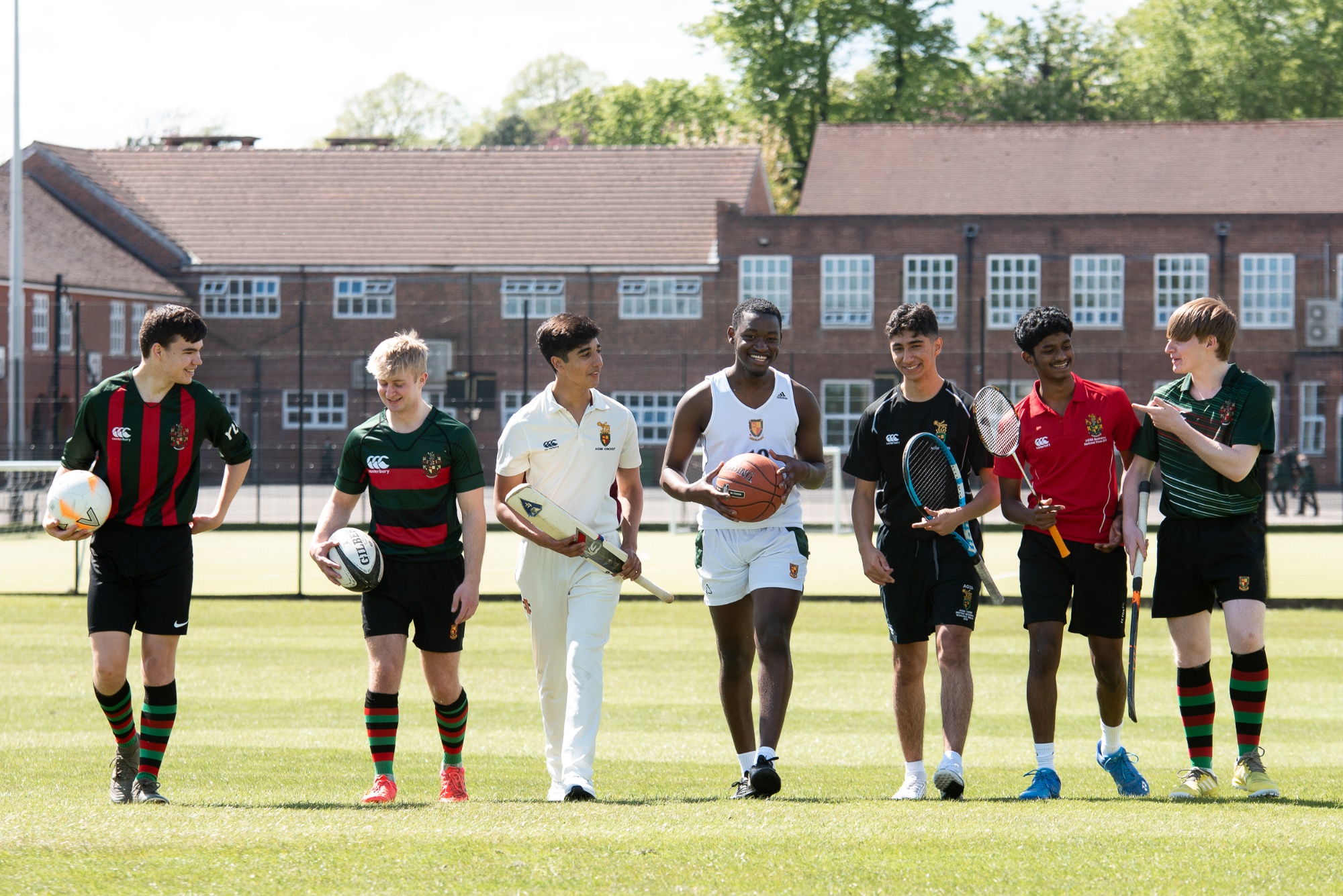
CAREERS AND LINKS WITH INDUSTRY
- Aspirations
- Careers Guidance
- Work Shadowing / Internships

OTHER ELEMENTS OF THE CURRICULUM
- ACE Lessons
- ACE Lecture Programme
- Physical Education
OPTIONAL CURRICULUM
In addition to their A-levels students should choose at least one of the following three options, this will add depth to their experience and improve their personal statement and CV:
1) Massive Open Online Course (MOOC)
There is a wide range of MOOCs available. Students can select their own MOOC to complete, in consultation with their mentor. The MOOC could be related to their chosen future career/degree studies or related to a topic of wider interest. Students will have access to Unifrog which contains a useful tool for searching for relevant MOOCs.
2) Extended Project Qualification (EPQ)
The AQA Extended Project Qualification is a stand-alone qualification started towards the end of Year 12 and completed in Year 13. The EPQ requires commitment and passion, but rewards with some excellent skills in preparation for further study. It is worth 50% of the UCAS points awarded for a full A2 level and is highly regarded by leading Universities. Pupils choose their own topics and are assigned a supervisor in the School to guide them. Assessed work will be in the form of a 5,000-word essay or a 1,000-word essay and some form of artefact, video etc. In addition to this, pupils must keep a monitoring log of their progress and present their completed project to an audience. The project title cannot be on any element that is included in the syllabi that you are studying for A Level.
3) Fourth A-Level
Some students choose to pursue 4 A-Levels throughout Year 12 and Year 13; this includes those studying Further Mathematics. They will not have to choose between either a MOOC or an EPQ. However, some students may wish to undertake an EPQ following discussion with the Head of Sixth Form or a MOOC. A very small number of students may also choose to study 5 A-Levels
Careers and links with industry
Aspirations
We provide information to help our Sixth Form students develop their academic, extra-curricular and social interests into their “Aspirations”. Through the opportunities listed in the next sections of this document and many other events and activities we work closely with students to ensure they consider many post-18 options, which include Higher Education, Apprenticeships, Sponsorship, Gap Years, Year in Industry and many more. There is a wide range of information and a calendar of events which we hold within “The Engine”, a web-based resource that students can access, which includes a programme of visiting speakers, advice on job applications and employment rights, student finance, volunteering and much more.
Careers Guidance
All members of the Sixth Form are encouraged to consult with members of staff about education and employment opportunities at 18+. A student may, at any time, request an interview with our own Head of Careers, Mr Gallamore. This service and the Sixth Form team provide help and advice on a wide variety of matters including:
- Higher Education Choices
- HE procedure
- Electronic Application System
- Employment Opportunities at 18
- Year in Industry
- Interview techniques and practice
- Apprenticeship opportunities.
- Unifrog is an excellent tool which is made available to all students throughout their time in the Sixth Form.
Work Shadowing/Internships
All Year 12 students are required to arrange a Work Shadowing/Internship Placement in the last week of the Summer term. This enables the student to shadow a professional in a career area in which he himself may be interested in the future.
OTHER ELEMENTS of the CORE CURRICULUM
ace lessons
In this programme of study we have devised a carousel of lessons and activities, which will run over the two years of the Sixth Form course at AGSB. The objective of ACE is enrichment – making our students more rounded, more independent and more aware of the world we all inhabit. We hope it will help our students manage their studies and build up knowledge and skills which are relevant to life outside of the classroom. The course will be engaging, thought provoking and at times challenging.
The lessons are going to be ACE as we have utilised the wide ranging skills, experience and interests of our staff to ensure a varied programme of topics such as:
- Money and finance for University
- Mentor Sessions - focus on your progress and supporting you to cover challenges.
- Yoga
- Cooking skills
- Being an Ally
- Interview Techniques
- And much more!
ACE Lecture Programme
Each year a range of speakers visit the school to present on a variety of issues to our Sixth Form students. Attendance at these talks is compulsory for all students. The talks will be on a variety of different issues, examples of some include: Positive Mental Health, Alcohol & Sexual Health and Safe Driving Skills.
Physical Education
All pupils in the Sixth Form will have a session devoted to Physical Recreation on a Wednesday afternoon, unless they are involved in AGSB Volunteers or complete 4 A-Levels. In Year 13 students have the option to complete off-site sports activities. There will be a variety of activities available at School including social football, basketball, badminton and the fitness suite. Pupils will be required to ‘opt’ for an activity on a termly basis.
Extra-Curricular
The Sixth Form is not just about the pursuit of academic success. We also want our students to get involved and a variety of opportunities exist for them to contribute to the general life of the school and to the wider community. These activities should be seen as worthwhile and enjoyable in themselves, but of course, they are also of value in enhancing a student’s identity and increasing his chances of gaining access to appropriate higher education courses or employment. The school offers a wide range of activities, which in previous years have included:
- AGSB Volunteers Programme and Charity Work
- An award winning Esports team
- Chess Club
- Christian Union, Islamic Society, Hindu and Sikh Society
- Debating, Model United Nations and the Sixth Form Book Club
- Drama
- Music – the Choir, Barbershop, School Orchestra, Swing Band
- Public speaking competitions including ESU national competitions
- School sport – Soccer, Rugby, Cricket, Hockey
- The Library is also a valuable resource available to all students.
The Library 
Located in the brand new English and Geology block, the Library is an integral study space for pupils of all ages. At break times and lunch times, the library is open to all and hosts a variety of extra-curricular clubs and events. iPads are available to borrow and there are printing facilities.
The library’s fictional stock is updated regularly and has separate sections for the classics and for sixth form and staff-appropriate texts.
The Library also has a regularly updated Instagram page, agsblibrary, where we profile the latest books, news and reviews. Further stock information is also available on stu_library pages. "Further recommendations and regular events are spotlighted in the half termly Library Newsletter which is created by our Library team.
There is also a dedicated Games Room with a selection of board games to play as well as pupils bringing in their own.
If you need a hand finding something, our librarian is available on Wednesdays, Thursdays and Fridays, plus we also have a team of dedicated student librarians and sixth form English Prefects who help every day.
Library Extra-Curricular Timetable
- Debates and Public Speaking House Competitions are on Tuesday lunchtime.
- We have a lower school book club that participates in the TYRA event; voting for their winning book after reading a shortlist of 3 YA titles. We also meet the shortlisted authors at an Awards event and run workshops with other local schools.
Drama
Drama is a performing art. It is a discipline that has a unique appeal, it has immediacy; a “here and now impact” that creates a bond between performers and audience. A shared experience which at its very best is utterly compelling and absorbing: loosely translated as – it’s great fun! We are proud to say that extra-curricular drama at AGSB is vital and exciting. Our productions range from the magical, “A Midsummer Night’s Dream” to the fabulous, “West Side Story”, and most recently, “Guys & Dolls." We welcome any budding actors or technical crew alike to come and join the team at AGSB.
Music
Sixth Formers are welcome to join staff and junior boys in the School Choir which performs concerts at Christmas and in the Spring. They are also welcome to participate in any of the school instrumental groups; the Swing Band, the Orchestra or the Concert Band. Instrumental or vocal lessons continue to be available from beginners to advanced levels. For more details of the above, see the Music Department’s entry earlier in this prospectus.
Debating Society
Jointly run by staff and a committee of Sixth Formers, the Debating Society meets at lunchtime every week debating a wide range of political, economic and ethical issues. In recent years, members of the society have had great success, reaching the latter stages of a number of national public speaking and debating competitions. The society liaises with several local schools to hold regular joint debates while also giving sixth formers wider experience of organising and mentoring students lower down the school.
Model United Nations
The School's MUN Society offers students an opportunity to hone their debating skills while also adding a unique role-play/drama element, with “delegates” debating “in role” representing different member states. MUN conferences are regularly held at Manchester Grammar School, Withington Girls’ and Cheadle Hulme School. The Society is largely student-run and provides a great grounding for those interested in careers in law, civil service, politics and public life.
AGSB Volunteers
AGSB Volunteers is our Community Service Scheme. Our target is that all of our Sixth Form students complete some form of volunteering whilst they are in the Sixth Form. Students take part in the various activities available, either on Wednesday afternoons or during another morning or afternoon when they have one or two free periods.
The range of opportunities we offer in the community is extensive and is subject to change as we try to cater for the interests of the students involved. A number of our Sixth Formers visit primary and junior schools or help in charity shops. They often choose to help at schools they attended when they were younger. Another popular option is to assist in retirement and nursing homes. The residents look forward to visits by young people who can chat to them or play cards or board games. Several students opt to do their Community Service at hospitals, although the number of places is limited and students must find and progress their own applications.
Through these activities, we are keen to help the community, but also to broaden the experience of our students and give them an insight into aspects of delivering services to local people. Our students also find their community service option a very useful topic to include when completing application forms for employment or for university or college courses.
School Sport
As mentioned previously, there are many opportunities to take part in sport, whether in teams or otherwise. Most activities are now held on-site within the Sports Development.